How to Connect PostgreSQL with Google Sheets (With or Without an AI Agent)
Connect PostgreSQL and Google Sheets so database rows sync to a live sheet automatically, then optionally run the connection as an AI agent that pauses for human approval before any bulk write.
How do you connect PostgreSQL to Google Sheets?
Use a FlowRunner flow with a Select Rows action on PostgreSQL and an Add Row or Update Row action on Google Sheets: the flow queries your database on a schedule or in response to an event and writes the results directly into the sheet. FlowRunner is a visual AI-agent orchestration platform where automations run autonomously and pause for human judgment on the steps that carry real consequence. The same connection that pushes rows automatically can run as an AI agent that reads what it finds, reasons about whether the write is safe, and calls a human before touching a production table.
The problem most teams are still solving with a spreadsheet
The operations team keeps a Google Sheet because it is the one place everyone can see the numbers. Someone pulls a report from the application database, pastes it in, fixes the column headers, and sends the link. By the time the link lands in inboxes, the data is already a day old. When a discrepancy shows up, the billing manager opens a second tab and starts comparing rows by eye. Exceptions fall through the cracks because no one owns the comparison step and there is no record of who looked at what.
The database itself is not the problem. PostgreSQL has the data. The gap is that getting it into the sheet is a manual job that depends on a person remembering to do it. When that person is busy, or out, the sheet freezes in place while the database keeps moving. Reconciliation becomes a recovery task rather than a routine one.
How it works: the connection
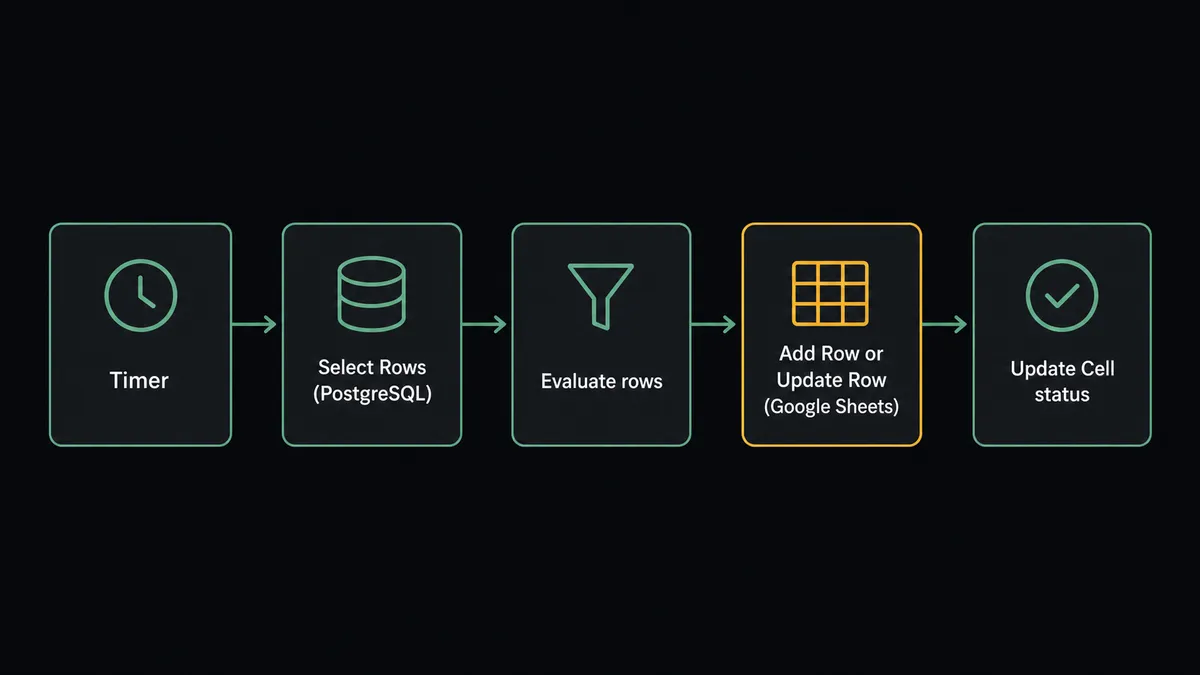
A FlowRunner flow wires PostgreSQL and Google Sheets together as two sides of the same step sequence.
On the PostgreSQL side, the agent calls Select Rows to pull the records that matter for this run. It uses equality filters and column selection to return only what it needs, without writing SQL by hand. For cases that require joins or custom logic, Execute Query runs any parameterized statement with $1, $2 placeholders, so values are bound safely and no input is concatenated into the query string.
On the Google Sheets side, the agent calls Add Row to append a new record, Update Row to write a status back to an existing one, or Find Row to locate a record before updating it. If the sheet’s header row might shift, the agent calls Load Header Row first so it addresses columns by name rather than position.
The data mapping is set once in the flow. After that, the connection runs without anyone opening either system.
For teams that need the reverse direction, the On New Row trigger fires the moment a row lands in a watched sheet. The agent reads the row values, runs the relevant PostgreSQL query, and writes the result back. One trigger. No polling script. No cron job that someone has to monitor.
Can an AI agent run it? (And why a human stays in the loop)
A plain sync copies rows. An AI agent decides whether copying them is the right call.
The agent reads what Select Rows returns. It does not just pass the data downstream. It checks whether the values match what the flow expects, whether the row count is within the normal range, and whether anything in the result looks like it needs a person before it becomes a database write. This is not a hardcoded rule. The agent reasons about what it found.
When the agent decides to escalate, it invokes a human-in-loop subflow as a callable tool. Here is what that looks like in practice:
The agent runs Select Rows against public.invoices and finds 4,812 rows matching the filter. That is three times the normal weekly batch. Before calling Update Rows, the agent pauses. It packages the Where object, the row count, and a sample of the affected records, then sends a Slack message: “This Update Rows on public.invoices would touch 4,812 rows. The usual batch is under 1,500. Here is the filter and a sample. Approve, adjust the filter, or cancel.” This is the digital andon cord: the agent stops the line when it hits something that warrants human judgment.
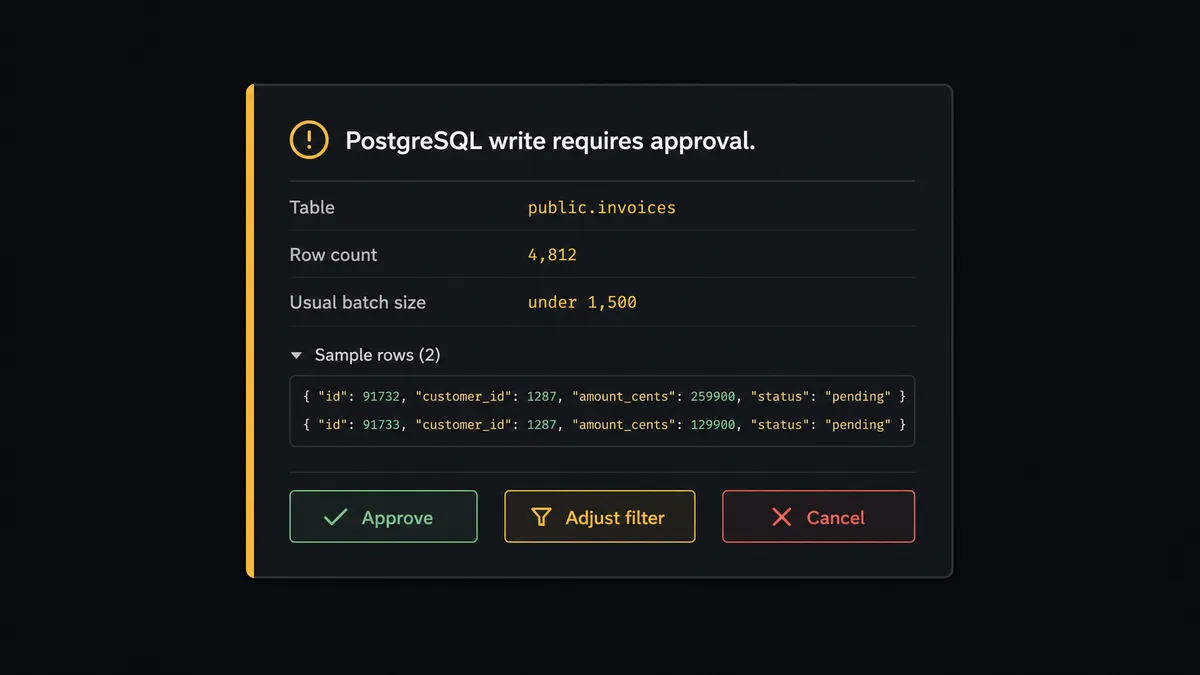
The human sees exactly what the agent saw: the table, the filter, the count, and the sample. They approve, adjust the filter, or cancel. The agent resumes with the decision as input. The approver’s identity and the timestamp go into the run log. Nothing about the original sync changes for the rows that did not trigger the gate.
This is not a sync tool. The agent knows when to stop and ask.
FlowRunner vs Zapier
If you searched for a way to connect PostgreSQL and Google Sheets, you have probably looked at Zapier. It is a fair comparison. Zapier has a large integration library, a straightforward setup, and a free tier. For simple appends, it works.
The differences become real when the data is not clean or the writes are not small.
| What matters | Zapier | FlowRunner |
|---|---|---|
| Human-in-loop | No native escalation; a filter step can halt a Zap but does not route for approval | Native: agent invokes a human-in-loop subflow as a callable tool; approver and timestamp in the audit trail |
| Database write safety | No write guards; an action with a misconfigured filter can overwrite a table | Update Rows and Delete Rows require an explicit Where object; the agent refuses to run without it |
| Agent reasoning | Condition steps follow a fixed logic tree | AI Agent reads the data, reasons about it, and chooses which actions to call based on what it finds |
| Pricing model | Per-task pricing; a batch of 4,000 rows is 4,000 tasks | Workflow-based executions; a 4,000-row batch is one flow run |
| Users and workflows | Seat-based and plan-limited on higher tiers | Unlimited users and unlimited workflows on every tier |
| Self-host | Not available | Community Edition free; Enterprise self-hosted available |
Zapier is a strong choice for simple linear automations. FlowRunner is the choice when the writes are consequential, the data is messy, or the team needs to know what ran, why, and who approved it.
Before and after
| Before | After | |
|---|---|---|
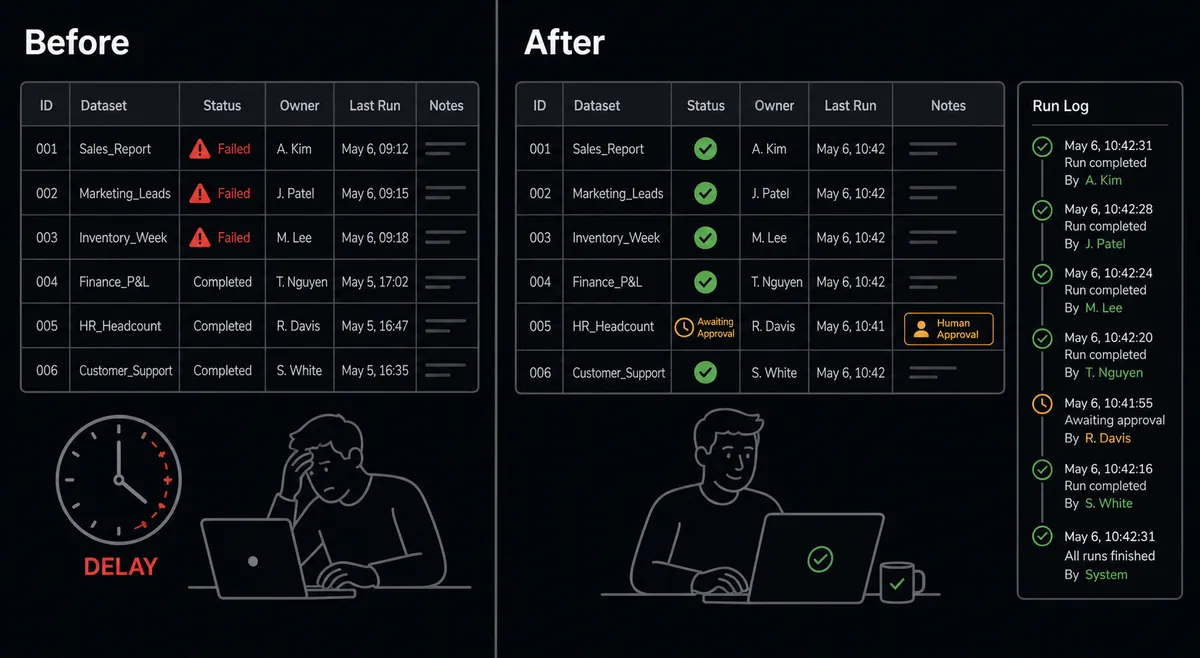
| Data freshness | Sheet is updated manually, once a week, by whoever remembered | Flow runs on schedule or on trigger; sheet reflects the database without anyone opening either system |
| Reconciliation | Billing manager compares two exports side by side, row by row | Agent runs Select Rows, identifies conflicts, and surfaces only the rows that did not match cleanly |
| Write safety | An Update with a missing filter can rewrite a table; no one catches it until the damage is done | Update Rows and Delete Rows require a Where object; bulk writes above the row threshold pause for approval |
| Exception handling | Exceptions fall through the cracks when the person who spots them is out | Agent flags the row, routes it to the owner via Slack, and holds it until a human clears it |
| Audit trail | No record of who exported what or when | Every flow run is logged: which rows were read, which were written, who approved the escalation, and when |
What you can build
Nightly reconciliation with a human gate on bulk writes. The agent calls Select Rows to pull open invoices from PostgreSQL, compares them against payment records from another connector, and calls Update Rows for clean matches. When the batch exceeds the threshold, it pauses for approval before executing. The controller starts each day reviewing only the exceptions the agent could not resolve.
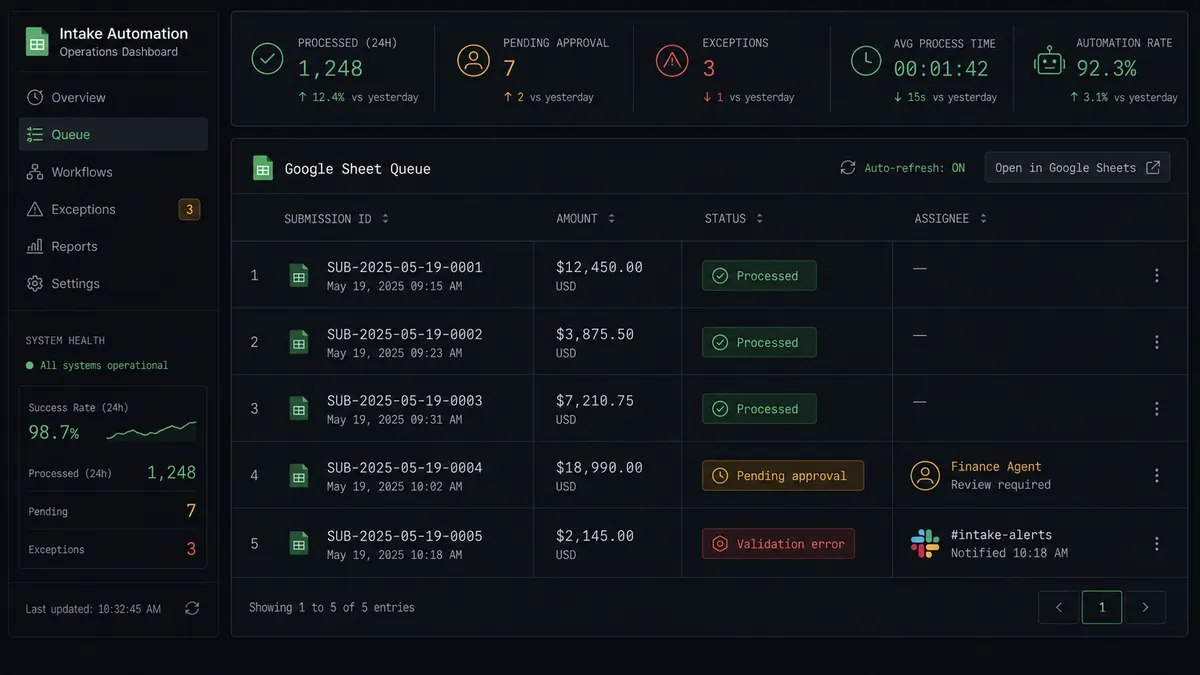
Form submission to database and sheet in one flow. A Google Sheets On New Row trigger fires when a form response lands. The agent validates the row with Find Row to check for a duplicate, calls Insert Row or Upsert Row on PostgreSQL to write the canonical record, then calls Update Row on the sheet to mark the submission processed. Duplicates are caught before they reach the database.
Scheduled report export from a live sheet. The agent calls Select Rows on PostgreSQL to load the week’s data, bulk-appends it with Add Rows to a reporting sheet, then calls Export Sheet to generate a PDF and passes the URL to an email step. The report lands in inboxes without anyone opening the spreadsheet.
Schema-aware sync that adapts to your table. Before writing computed results, the agent calls Get Table Schema to confirm the target columns exist and match the expected types. If the schema has changed, the agent flags it and routes to the ops lead before proceeding. No silent failures from a column rename.
Row validation with a hold queue. The On New or Updated Row trigger fires on every change. The agent validates each row against required fields using Get Cell to spot missing values. Valid rows proceed to downstream systems. Invalid rows are marked with Format Row in the sheet and held in a queue. The agent sends a Slack message to the data owner: “Row [N] is missing a value in the Amount column. Correct it and I will reprocess, or tell me to skip.” Clean rows flow automatically. Messy ones wait for a human.
Getting started
FlowRunner has a free plan with 100 executions a month, every integration included, and no credit card required, and new accounts get 14 days of Professional on top. Corporate email gets you in.
The PostgreSQL connector and the Google Sheets connector are both available on every tier, including the trial. You can build the full flow, including the human-in-loop gate, before you spend a dollar.
Start at flowrunner.ai or book a 30-minute walkthrough at calendly.com/flowrunner/intro.
The integration pages have the full action reference if you want to plan the flow before you build: PostgreSQL on FlowRunner and Google Sheets on FlowRunner.
Frequently asked questions
Is it free to connect PostgreSQL and Google Sheets on FlowRunner?
FlowRunner has a free plan with 100 executions a month, every integration included, and no credit card required, and new accounts get 14 days of Professional on top. Beyond the free plan, Growth is $45 per month for 12,000 executions. All tiers include unlimited users and unlimited workflows.
Can I self-host FlowRunner if my PostgreSQL data is sensitive?
Yes. FlowRunner offers a self-hosted Community Edition at no cost and an Enterprise self-hosted tier for multi-instance deployments. Your database credentials never leave your infrastructure.
Does the AI agent need my own OpenAI key?
FlowRunner uses a bring-your-own-key model for AI providers. You connect whichever LLM provider you prefer, including OpenAI, Anthropic, or others, and the agent uses your key. FlowRunner never bills separately for AI model calls.
What happens when the agent is not sure whether a database write is safe?
The agent pauses the workflow and routes the decision to a human via Slack, email, or WhatsApp. It packages the SQL filter, the affected row count, and a sample of the rows before asking. The write only runs after a person approves, and the approver and timestamp are captured in the audit trail.
Can I trigger a flow from Google Sheets and write the result back to PostgreSQL?
Yes. The On New Row or On New or Updated Row trigger fires when a row lands in your sheet. The agent reads it, executes logic against your PostgreSQL database with Select Rows or Execute Query, and then writes a result back to the sheet using Update Row.
How is FlowRunner different from a script that queries PostgreSQL and writes to Sheets?
A script runs blind. FlowRunner gives every step a run log, enforces write guards (Update Rows and Delete Rows require an explicit Where object), and lets the agent decide when to pause and escalate rather than failing silently or overwriting data without oversight.